
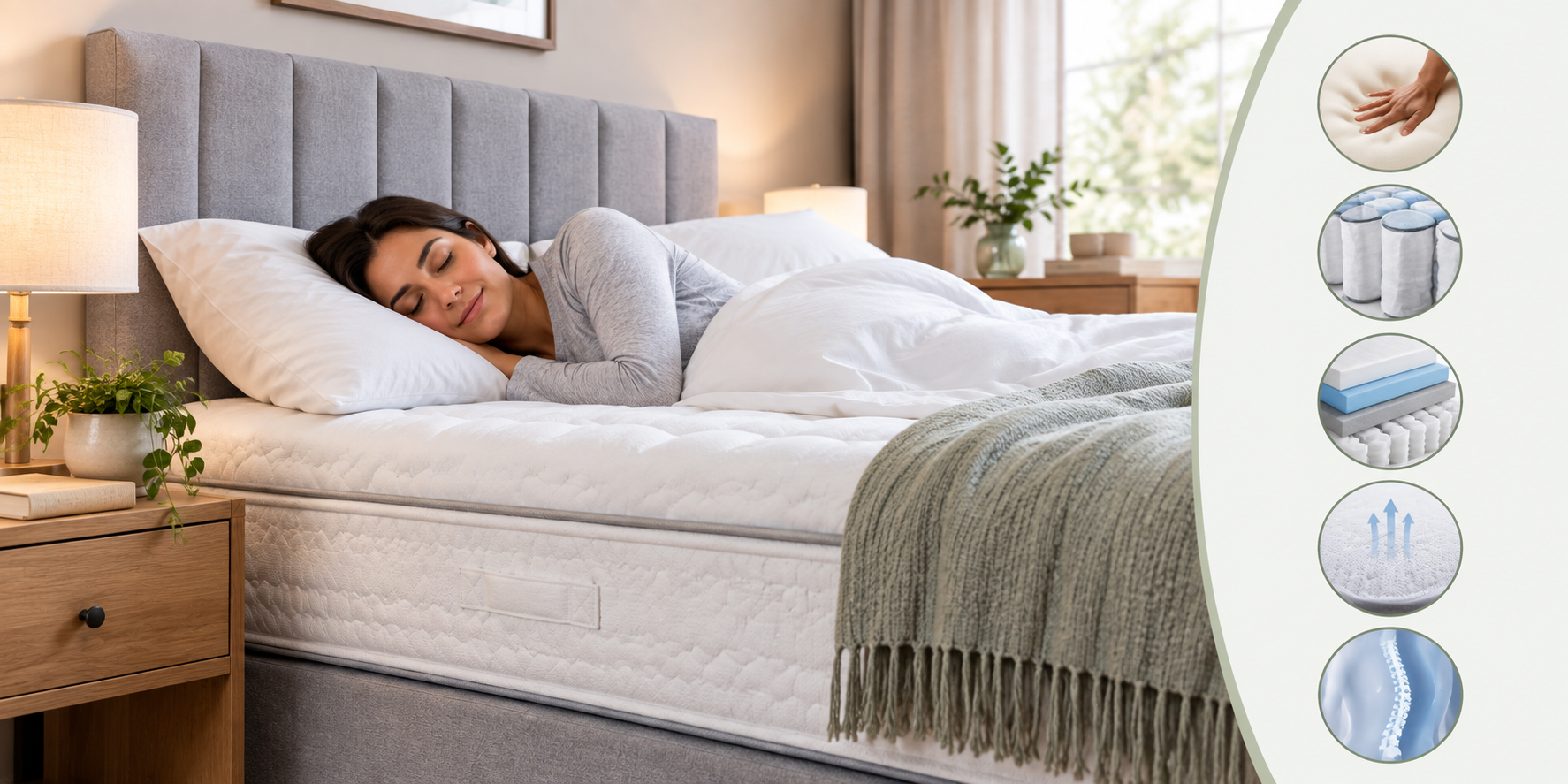
Finding the best mattress for back pain is not simply about choosing the firmest mattress you can find.
Your sleeping position, body weight, mattress construction and personal comfort all affect how a mattress feels and how well it supports you through the night. A mattress that feels comfortable for one person may feel too hard or too soft for someone else.
If you wake up with a stiff lower back, struggle to get comfortable at night or feel that your current mattress no longer gives you enough support, it may be time to look at your options.
This guide explains what to look for when choosing a mattress for back pain, including firmness, mattress types, sleeping positions and some of the options available from JMH Beds.
Important: A mattress can affect comfort and sleep quality, but it is not a treatment for a medical condition. If your back pain is persistent, severe or getting worse, speak to a GP or qualified healthcare professional.
What Makes a Mattress Supportive?
A supportive mattress should help keep your body in a comfortable, well-supported position while you sleep.
That does not necessarily mean the mattress needs to feel extremely firm.
If a mattress is too soft for you, your heavier areas may sink too far into the surface. If it is too firm, you may feel excessive pressure around areas such as your shoulders and hips.
The aim is to find a balance between support and comfort.
JMH Beds describes its mattress collection as providing firm, even support and pressure relief, with several constructions available to suit different preferences.
Is a Firm or Soft Mattress Better for Back Pain?
One of the most common questions is whether you should choose a firm or soft mattress for back pain.
There is no universal answer.
A very soft mattress may allow your hips and midsection to sink more than you find comfortable. On the other hand, an extremely firm mattress may create pressure at the shoulders, hips and other contact points.
For many sleepers, a medium-firm feel can provide a useful starting point because it offers a combination of cushioning and support. Your body weight and sleeping position still matter, though.
Rather than choosing a mattress because it is labelled “firm”, consider how your body feels when lying on it.
How Your Sleeping Position Matters
Your sleeping position can change which areas need more cushioning and support.
Back sleepers generally need enough support beneath the lower back and hips without allowing the middle of the body to sink excessively.
Side sleepers often need more cushioning around the shoulders and hips because these areas carry more pressure against the mattress.
Front sleepers may prefer a supportive surface that limits excessive sinking around the hips and stomach.
If you change positions throughout the night, look for a mattress that provides a balance rather than being designed around only one sleeping position.
Mattress Types for Back Support
The construction of a mattress makes a noticeable difference to its feel.
JMH Beds offers several mattress styles, including pocket sprung, memory foam, memory pocket, cooling gel, pillow top and orthopaedic options.
Pocket Sprung Mattresses
Pocket sprung mattresses contain individual springs housed in fabric pockets.
The springs can respond independently to pressure, which helps the mattress adapt to different areas of the body.
Pocket sprung mattresses can suit people who prefer a more responsive feel rather than the deeper, slower feel associated with some memory foam mattresses.
JMH’s collection includes the Diamond 2000 Pocket and Platinum 3000 Pocket mattresses, giving shoppers different spring-count options to compare.
Memory Foam Mattresses
Memory foam moulds around the body when exposed to heat and pressure.
This creates a more cushioned, contouring feel and can help distribute pressure across the sleeping surface.
If you prefer a mattress that feels like it gently moulds around you rather than pushing back immediately, memory foam may be worth considering.
JMH Beds offers the Topaz Memory Mattress and Universal Full Memory Foam Mattress as part of its range.
Memory Pocket Mattresses
A memory pocket mattress combines pocket springs with a memory foam comfort layer.
You get the responsive support of springs alongside the contouring feel of foam.
This type of mattress can be useful if you want some pressure cushioning without moving completely away from a traditional sprung mattress.
JMH’s Ruby 1000 Memory Pocket Mattress is one example in its current collection.
Orthopaedic Mattresses
An orthopaedic mattress is generally associated with a firmer level of support.
JMH Beds offers an Orthopaedic Firm Mattress for customers looking for a firmer sleeping surface.
However, don’t assume that an orthopaedic label automatically makes a mattress better for every person with back pain.
Pay attention to the actual construction and firmness, then consider whether that feel suits your sleeping position and personal comfort.
Best Mattress for Back Sleepers
If you normally sleep on your back, the mattress should feel supportive beneath your body without creating uncomfortable pressure.
A mattress that allows your hips to sink too deeply may not feel right. Equally, a surface that feels excessively hard can make it difficult to settle comfortably.
Pocket sprung and firmer mattress designs may be worth comparing if you prefer a supportive, responsive feel.
An orthopaedic-style mattress may also appeal to people who specifically prefer a firmer surface, but comfort should remain part of the decision.
Best Mattress for Lower Back Pain
When shopping for the best mattress for lower back pain, focus on how well the mattress supports your sleeping position.
Your lower back should not feel as though it is being forced into an uncomfortable position.
Try to think beyond the first few minutes of lying on a mattress. A mattress can feel comfortable initially but may not suit you after several hours of sleeping.
If possible, use a proper trial period when buying online. This gives you more time to assess how your body responds to the mattress at home.
JMH Beds currently states that its standard products include a 14-day risk-free trial and exchange option, while its website also advertises a longer comfort period elsewhere, so check the current terms for the specific product before ordering.
Consider Your Body Weight
Body weight can change how firm a mattress feels.
A mattress that feels firm to one person may feel softer to someone heavier because more pressure is placed on the mattress.
This is particularly important when comparing mattresses for back support.
If you are above average in body weight, you may prefer a mattress with stronger support and a firmer feel. If you are lighter, a very firm mattress may feel harder because your body does not sink into the comfort layers as much.
Don’t use body weight as the only deciding factor, but include it when comparing different firmness options.
What About Couples?
Choosing a supportive mattress for back pain becomes slightly more complicated when two people share the bed.
You may have different body weights, sleeping positions and firmness preferences.
For couples, consider:
- Movement transfer
- Mattress size
- Firmness preference
- Individual body weight
- Sleeping positions
- Edge support
- Whether both people can sleep comfortably on the same surface
A memory pocket mattress can be worth considering when you want the combination of spring support and foam cushioning.
Pocket springs can also provide a responsive feel while helping the mattress respond to pressure across different areas.
Mattress Firmness Guide for Back Pain
Use firmness as a starting point, not an absolute rule.
| Mattress feel | May suit | What to consider |
| Softer | Some side sleepers | More cushioning around pressure points |
| Medium | Mixed sleeping positions | Balance between cushioning and support |
| Firm | Back or front sleepers who prefer stronger support | May feel too hard for some sleepers |
| Orthopaedic firm | People who prefer a firmer surface | Check the actual construction and comfort |
Your ideal firmness depends on how the mattress feels underneath your body.
The right mattress should feel supportive without creating obvious pressure or forcing you into an uncomfortable sleeping position.
How to Choose the Right Mattress for Back Pain
Before buying, work through these questions.
1. How Do You Sleep?
Are you mainly a side, back or front sleeper?
2. What Does Your Current Mattress Feel Like?
Is it too soft, too firm, sagging or simply uncomfortable?
3. Do You Prefer Springs or Foam?
Pocket springs provide a more responsive feel, while memory foam gives you more contouring.
4. Do You Sleep Hot?
If temperature is an issue, compare the materials and construction carefully. JMH offers a 1000 Pocket Memory Cooling Gel Mattress for people looking for a cooling-focused option.
5. Are You Sharing the Bed?
Consider movement transfer and whether both sleepers have similar firmness preferences.
6. Is Your Bed Base Suitable?
A good mattress still needs a suitable base. Check the manufacturer’s requirements before placing a new mattress on an existing bed.
JMH Beds Mattresses for Different Preferences
JMH Beds has a range of mattresses covering different constructions and comfort preferences.
Its current collection includes:
- Orthopaedic Firm Mattress for a firmer feel
- Diamond 2000 Pocket Mattress for pocket sprung support
- Platinum 3000 Pocket Mattress for a higher spring-count option
- Ruby 1000 Memory Pocket Mattress combining springs and memory foam
- Topaz Memory Mattress for a memory foam feel
- Universal Full Memory Foam Mattress
- Canterbury 2000 and 3000 Pillow Top Mattresses for a supportive core with additional surface cushioning
- 1000 Pocket Memory Cooling Gel Mattress for a cooling-focused memory pocket design
This gives shoppers several constructions to compare instead of forcing everyone into the same mattress type.
JMH Beds also states that its products are made in the UK and offers fast delivery, flexible payment options and a manufacturing warranty.
When Should You Replace Your Mattress?
Sometimes the problem isn’t choosing the wrong mattress. Your existing mattress may simply have reached the end of its useful life.
Look for signs such as:
- Visible sagging
- Permanent dips
- Damaged springs or materials
- Increasing discomfort
- Lack of support
- Waking up stiff or uncomfortable
- Feeling more comfortable when sleeping elsewhere
If your mattress no longer feels supportive, replacing it may make more sense than trying to compensate with extra toppers or bedding.
Does a New Mattress Cure Back Pain?
A mattress should not be treated as a cure for back pain.
It can influence your comfort, sleep position and how supported you feel during the night, but back pain can have many different causes.
If you have ongoing pain, numbness, weakness or other concerning symptoms, speak to a healthcare professional rather than relying on a mattress change alone.
For everyone else, choosing a mattress that feels comfortable, supportive and appropriate for your sleeping position can help create a better sleep environment.
Frequently Asked Questions
1. What is the best mattress for back pain in the UK?
There is no single mattress that is best for every person with back pain. A supportive medium-firm or firm mattress may suit some sleepers, while others may prefer a memory pocket design with more cushioning. Your sleeping position, body weight and personal comfort all matter.
2. Is a firm mattress better for lower back pain?
Not necessarily. A very firm mattress can feel supportive to some people but uncomfortable to others. Look for a mattress that supports your body without creating excessive pressure or allowing your hips to sink too far.
3. What is the best bed mattress for back pain?
The best bed mattress for back pain is one that provides suitable support and comfort for your body and sleeping position. Pocket sprung, memory pocket and firmer mattresses are all options worth comparing rather than choosing purely from the name.
4. Is an orthopaedic mattress good for back pain?
An orthopaedic mattress generally offers a firmer feel, which some sleepers may prefer. However, the term does not mean that every orthopaedic mattress will suit every person with back pain. Check the mattress construction and firmness before buying.
5. What mattress firmness is best for back pain?
Many people start by considering a medium-firm mattress because it offers a balance between cushioning and support. However, the right firmness depends on body weight, sleeping position and personal preference.
6. What is the best mattress for back sleepers?
Back sleepers generally need a mattress that supports the lower back and hips without allowing the body to sink excessively. Pocket sprung and firmer mattresses can be useful options to compare, depending on your preferred feel.
7. Is memory foam good for back pain?
Memory foam can provide a contouring feel that cushions the body and distributes pressure. Whether it suits you depends on your sleeping position, firmness preference and how you respond to the feel of foam.
8. Are pocket sprung mattresses good for back support?
Pocket sprung mattresses can provide responsive support because individual springs respond to pressure. The overall support still depends on the spring unit, comfort layers and construction of the particular mattress.
9. Should side sleepers with back pain choose a firm mattress?
Not automatically. Side sleepers often need enough cushioning around the shoulders and hips. A mattress that is too firm may create uncomfortable pressure, so compare the firmness with the amount of cushioning provided by the comfort layers.
10. How do I choose the right mattress for back pain?
Start with your sleeping position, body weight and preferred firmness. Then compare mattress constructions such as pocket springs, memory foam, memory pocket and orthopaedic designs. Check the mattress dimensions, bed-base compatibility, trial terms and warranty before ordering.
Find the Right Mattress for Your Sleep
The best mattress for back pain is not necessarily the hardest or most expensive mattress.
Start with how you sleep and how your current mattress feels. Then compare firmness, construction and support. If you prefer a responsive surface, look at pocket sprung options. If you want more contouring, consider memory foam. If you want both, a memory pocket mattress can provide a middle ground.
JMH Beds offers a range of UK-made mattresses in different constructions and firmness options, giving you plenty to compare before making your choice.
Take your time, check the specifications and choose a mattress that feels supportive and comfortable for your own body.


