
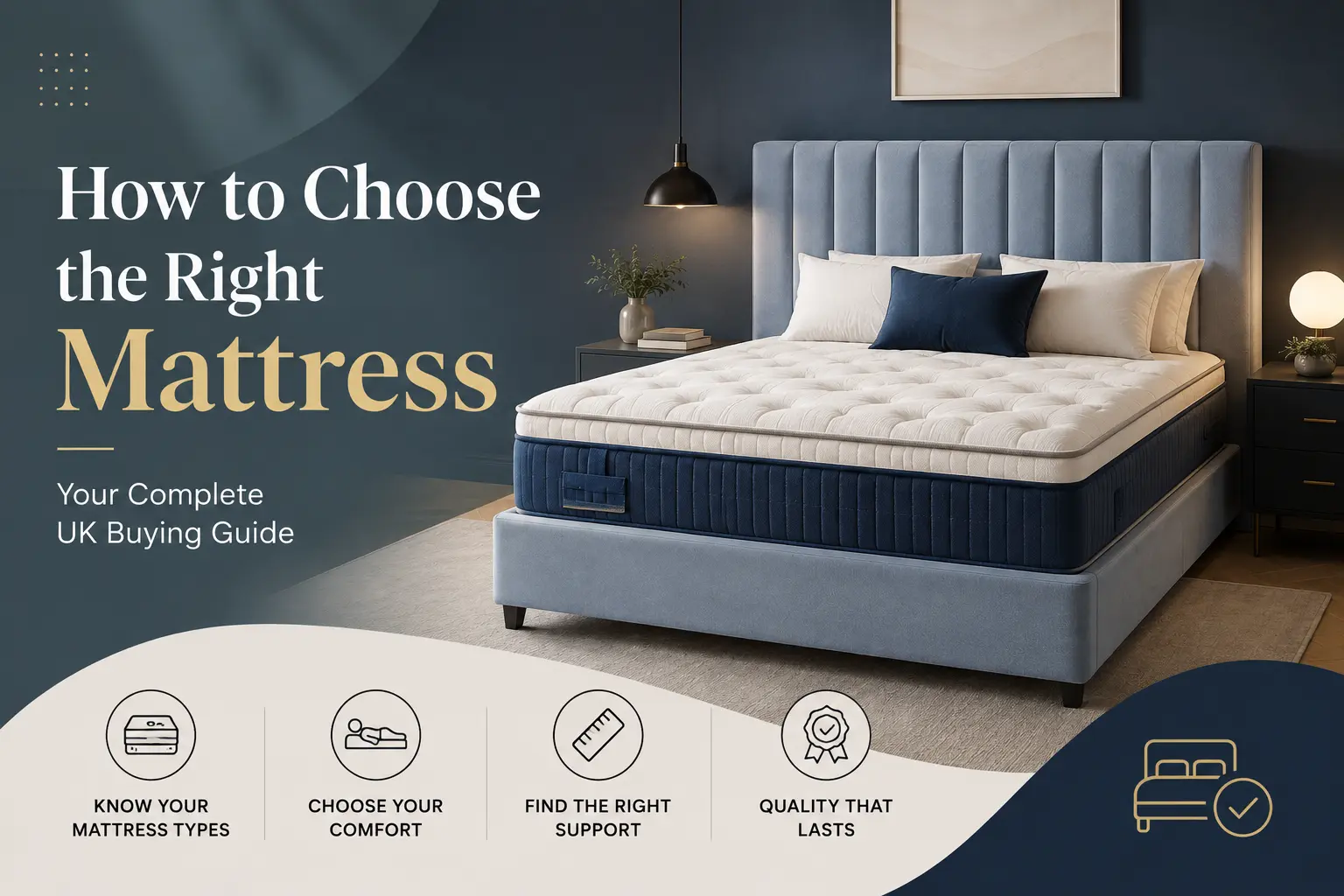
Buying a mattress online feels like a gamble. You cannot lie on it, the descriptions all sound the same, and every brand claims theirs is the most comfortable one on the market. Then it arrives, you sleep on it for a week, and you either love it or you regret the whole thing.
This guide fixes that. We build mattresses in West Yorkshire and talk to customers every day about what went wrong with their last one, so this is the same advice we give on the phone. By the end you will know which type suits you, what firmness to pick, what thickness actually matters, and which UK size fits your room.
Start With What Went Wrong Last Time
Before you look at a single product, work out why you are replacing your current mattress. The answer usually points straight at what you need.
- You wake with lower back ache. Your mattress is too soft and your hips are sinking.
- You wake with shoulder or hip pain. It is too firm and pressure is building at those points.
- You roll into the middle. The mattress has sagged and lost support.
- You overheat at night. Dense foam is trapping body heat.
- Your partner wakes you every time they move. Open coil springs are transferring motion.
Write your answer down. Every decision below gets easier once you know the actual problem.
Mattress Types Explained
Open Coil Mattresses
These use one connected wire spring system. They are the cheapest option and fine for a guest room or a bed that gets used a few nights a month. For everyday sleep they wear unevenly and transfer movement badly. Our Harmony mattress sits in this budget bracket at around £129.
Best for: spare rooms, occasional use, tight budgets.
Pocket Spring Mattresses
Each spring sits in its own fabric pocket and moves on its own. That means the mattress supports your shoulders and hips separately instead of as one lump, and your partner turning over barely registers on your side.
Spring counts run from 1000 up to 3000 and beyond. Our range includes the Diamond 2000 Pocket at around £220 and the Platinum 3000 Pocket at around £260.
Best for: couples, anyone who wants traditional support with proper contouring.
Memory Foam Mattresses
Memory foam softens with body heat and moulds around your shape, which spreads your weight and takes pressure off hips and shoulders. Full foam mattresses have zero bounce and zero motion transfer.
The trade off is heat. Older foam runs warm. Our Universal Full Memory Foam comes as a 2 inch foam layer over an 8 inch base, and the Topaz Memory sits around £160.
Best for: side sleepers, joint pain, light and restless sleepers.
Memory Pocket and Hybrid Mattresses
This is the middle ground most people end up choosing. Pocket springs handle the support, a memory foam layer on top handles the comfort. You get contouring without sinking and airflow through the spring unit stops the heat build up.
Our Ruby 1000 Memory Pocket runs around £190, and the 1000 Pocket Memory Cooling Gel adds a gel layer for anyone who sleeps hot, at around £249.
Best for: couples with different preferences, hot sleepers, most people generally.
Orthopaedic Mattresses
Orthopaedic means firmer support built to hold the spine in line. Worth knowing: the word is not a medical certification in the UK, it is a firmness description. A good orthopaedic mattress genuinely helps people with back problems, but always check the actual build rather than trusting the label. Our Orthopaedic Firm sits around £169.
Best for: back sleepers, heavier sleepers, people who need firm support.
Pillow Top Mattresses
A pillow top adds a stitched comfort layer on the surface. You get a firm supportive core with a softer welcome on top, which suits people who want support without the hard first impression. The Canterbury 2000 runs around £240 and the Canterbury 3000 around £280.
Best for: anyone who wants firm underneath and soft on the surface.
Pocket Springs vs Memory Foam: The Real Difference
| Pocket Springs | Memory Foam | |
|---|---|---|
| Support style | Pushes back against you | Moulds around you |
| Temperature | Cooler, springs allow airflow | Warmer unless gel cooled |
| Motion transfer | Very low | Almost none |
| Bounce | Yes | No |
| Edge support | Stronger | Weaker |
| Feel | Traditional, responsive | Slow, hugging |
| Lifespan | 8 to 10 years | 7 to 10 years |
Neither is better across the board. Pick springs if you like a responsive surface and sleep warm. Pick foam if you want pressure relief and a still, quiet bed. Pick a memory pocket hybrid if you cannot decide, which is honestly most people.
Firmness: Getting This Right Matters Most
Firmness gets described on a 1 to 10 scale across the industry, though nobody applies it identically.
- Soft (3 to 4): the surface gives easily and your shoulder sinks in
- Medium (5 to 6): balanced, works for most sleepers
- Medium firm (6 to 7): the most popular choice in the UK
- Firm (8 to 10): minimal give, strong support
Here is the thing people get wrong. Soft does not mean comfortable and firm does not mean supportive. A mattress that is too firm creates pressure points at your hips and shoulders. A mattress that is too soft lets your midsection drop and bends your spine into a curve all night.
You want your spine roughly level when you lie down, whatever position you sleep in.
Match Firmness to Your Sleeping Position
Side Sleepers
Your shoulder and hip carry your whole body weight against the mattress. You need enough give for them to sink in while your waist stays supported. Go soft to medium, and lean towards memory foam or a memory pocket hybrid.
Sign you got it wrong: numb arm, sore shoulder, or a hip that aches when you stand up.
Back Sleepers
Your lower back needs filling in, not sinking. Go medium to medium firm. Pocket sprung or orthopaedic works well here.
Sign you got it wrong: lower back ache first thing in the morning.
Front Sleepers
Sleeping on your stomach already pushes your neck and lower back out of line, so the last thing you want is your middle sinking. Go firm. Use a thin pillow too, or none at all.
Sign you got it wrong: aching lower back and a stiff neck.
Combination Sleepers
If you change position several times a night you need something responsive that lets you move. Go medium firm with pocket springs, because deep memory foam makes turning over harder.
Your Body Weight Changes Everything
Two people can buy the same mattress and have completely different experiences. Weight is why.
Under 11 stone (70kg): You do not press far into the surface, so a firm mattress will feel like a plank. Go one step softer than the standard recommendation for your sleeping position.
11 to 15 stone (70 to 95kg): Standard firmness ratings apply to you fairly accurately. Medium to medium firm covers most cases.
Over 15 stone (95kg): You compress the comfort layers more, so a medium will feel soft and may sag early. Go firmer, and prioritise higher spring counts of 2000 or more, or a hybrid with a proper support core. Thickness matters more for you too.
For couples with a big weight difference, a hybrid with a decent spring count handles both bodies better than full foam.
Choosing a Mattress as a Couple
Sharing a bed doubles the complications.
- Different firmness preferences? Meet in the middle at medium firm, or add a topper on one side rather than compromising the whole mattress.
- One of you wakes easily? Pocket springs or memory foam both isolate motion well. Avoid open coil entirely.
- One of you sleeps hot? Choose a cooling gel or a pocket sprung hybrid over full memory foam.
- Sharing a double? A double gives each person 67cm of width, which is less than a cot. If your room takes a king, take the king. It is the single biggest sleep upgrade most couples make.
Mattress Thickness: What Actually Matters
Thickness ranges from around 15cm to 30cm plus. More is not automatically better, but very thin mattresses rarely have room for both a support core and a comfort layer.
- Under 18cm: kids beds, guest rooms, bunk beds
- 20 to 25cm: the sweet spot for adults, room for proper layering
- 25cm plus: deeper comfort layers, better for heavier sleepers
Two practical warnings. Check your bed frame side height, because a very deep mattress on a high divan can leave you climbing into bed. And on ottoman beds, extremely heavy deep mattresses put more strain on the gas struts, so check the weight rating.
UK Mattress Sizes
| Size | Metric | Imperial |
|---|---|---|
| Single | 90 x 190cm | 3ft x 6ft 3 |
| Small Double | 120 x 190cm | 4ft x 6ft 3 |
| Double | 135 x 190cm | 4ft 6 x 6ft 3 |
| King | 150 x 200cm | 5ft x 6ft 6 |
| Super King | 180 x 200cm | 6ft x 6ft 6 |
Two things worth knowing. UK sizes do not match European or American sizes, so imported bedding often fits badly. And if you are over 6ft tall, king and super king give you an extra 10cm of length that single and double sizes do not.
Measure your room, not just your bed. Leave at least 60cm walking space on any side you use, and check that drawers or an ottoman lid can still open.
How Long Should a Mattress Last?
Most quality mattresses last 7 to 10 years. Budget open coil ones give up closer to 5.
Replace yours when you notice:
- A visible dip or sag where you sleep
- Waking stiffer than when you went to bed
- Sleeping better in hotel beds than your own
- Springs you can feel through the surface
- Worsening allergy symptoms overnight
Getting the full lifespan out of it is simple. Rotate it head to foot every three months, use a protector from day one, let it breathe rather than sealing it under plastic, and make sure the base underneath is solid and not sagging itself. A tired base ruins a new mattress fast.
Which Mattress Should You Buy?
Quick shortcuts based on the most common situations:
- Bad back, back sleeper: orthopaedic or a 2000 pocket
- Side sleeper with hip pain: memory foam or memory pocket
- Couple, one restless: pocket sprung, 2000 or higher
- Sleeps hot: cooling gel pocket or a pillow top hybrid
- Heavier build: 2000 to 3000 pocket, firm, 25cm plus
- Guest room: open coil or a basic memory foam
- Kids bed: medium firm, under 20cm thick
Ready to Choose Yours?
Every JMH mattress is handcrafted in West Yorkshire and fully complies with UK fire safety regulations. Delivery runs 7 to 14 working days with a tracking link before it arrives, and you can spread the cost with Klarna, Clearpay or Snap Finance at 0% interest.
Still torn between two options? Call us on +44 7534 269866 or email info@jmhbeds.co.uk. Tell us your sleeping position, your rough weight and what hurts in the morning, and we will tell you honestly which one to pick. We would rather sell you the cheaper mattress that suits you than the expensive one that does not.
Browse the full mattress range or pair it with one of our handcrafted beds.
Frequently Asked Questions
1. How do I know which mattress firmness is right for me?
Start with your sleeping position, then adjust for body weight. Side sleepers want soft to medium, back sleepers want medium to medium firm, front sleepers want firm. If you weigh under 11 stone, go a step softer than that guidance because you will not compress the surface much. Over 15 stone, go a step firmer. The goal is a spine that stays roughly level, not a mattress that feels plush in the showroom.
2. Which mattress is best for back pain in the UK?
For most back pain, a medium firm pocket sprung or orthopaedic mattress works best because it supports the lumbar curve without letting your hips drop. Side sleepers with back pain often do better on a memory pocket hybrid, which relieves hip pressure while still supporting the spine. If the pain is persistent or getting worse, speak to a GP or physiotherapist before you spend money, since the mattress is not always the cause.
3. Pocket springs or memory foam, which should I choose?
Choose pocket springs if you sleep hot, like a responsive surface, or want stronger edge support. Choose memory foam if you want pressure relief around hips and shoulders and a completely still bed. A memory pocket hybrid gives you both and is the safest choice if you are unsure or buying for two people with different preferences.
4. How many pocket springs do I actually need?
For a double, 1000 springs is a solid everyday mattress and 2000 gives noticeably better contouring. Above 3000 the returns get smaller for most sleepers. Spring count matters more if you are heavier, since more springs spread the load and reduce sagging. Also remember counts are quoted for a king size, so a double contains proportionally fewer than the headline number.
5. What thickness of mattress should I buy?
Aim for 20 to 25cm as an adult, which leaves room for a proper support core and a comfort layer above it. Under 18cm suits kids beds, bunk beds and guest rooms. Over 25cm suits heavier sleepers who need deeper comfort layers. Check your bed base height too, because a deep mattress on a tall divan can make getting in and out awkward.
6. What are the standard UK mattress sizes?
Single is 90 x 190cm, small double 120 x 190cm, double 135 x 190cm, king 150 x 200cm and super king 180 x 200cm. UK sizes differ from European and American ones, so imported bedding often fits poorly. King and super king also add 10cm of length, which is worth having if you are over 6ft tall.
7. How often should I replace my mattress?
Every 7 to 10 years for a quality mattress, or around 5 for budget open coil. Do not wait for the calendar though. Replace it sooner if you can see a dip, feel springs through the surface, wake up stiffer than you went to bed, or consistently sleep better in hotels. Comfort declines slowly enough that most people put up with a worn out mattress far longer than they should.
8. Is a firmer mattress always better for support?
No, and this is the most common mistake people make. Firm and supportive are not the same thing. A mattress that is too firm creates pressure at your hips and shoulders and forces your spine out of line, especially for side sleepers and lighter people. Proper support means the mattress holds your spine level, which sometimes needs give rather than resistance.
9. Can two people with different firmness preferences share one mattress?
Yes, in most cases. Meet in the middle at medium firm and add a mattress topper on the side that wants it softer, which is cheaper and easier than compromising the whole bed. Pocket springs help here too, because each side responds to its own sleeper. A large weight difference makes a hybrid with 2000 springs or more a safer choice than full memory foam.
10. Do I need a new bed base when I buy a new mattress?
Not always, but check it honestly. A sagging or broken base will wreck a new mattress within months and often voids the warranty. Press down across the base and look for dips, broken slats or a soft middle. If it flexes where it should not, replace both together. A solid divan or ottoman base is the difference between getting seven years out of a mattress and getting three.


