
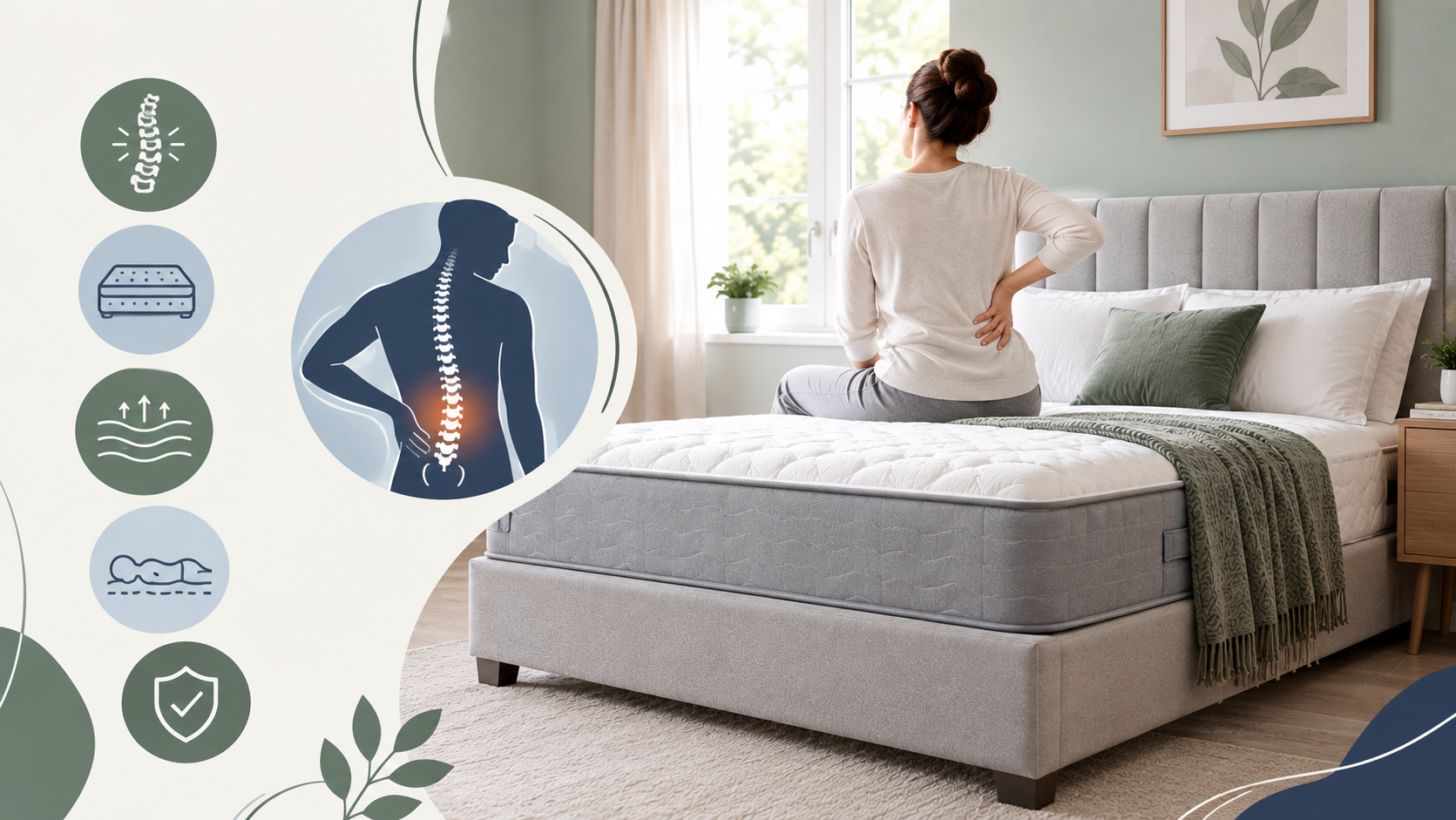
Waking up with a sore back is one of the most common reasons people replace a mattress, and it is also one of the easiest things to get wrong. The usual assumption is that firmer means more supportive, so people buy the hardest mattress they can find and end up in more pain than before.
Firm and supportive are not the same thing. This guide explains the difference, how to match a mattress to the type of back pain you have, and when the mattress is not actually the problem.
One thing first: we make beds, not medical advice. If back pain wakes you regularly, is getting worse, or comes with numbness or tingling down a leg, see a GP or physiotherapist. A mattress supports good sleep, it does not treat an underlying condition.
Why Your Mattress Affects Your Back
When you lie down, your spine should stay in roughly the same neutral alignment it holds when you stand with good posture. A mattress works against that in two ways.
Too soft and your hips and midsection sink deeper than your shoulders and feet. Your spine bends into a curve and holds that position for seven hours.
Too firm and your body cannot sink in where it needs to. Your hips and shoulders carry concentrated pressure, and the natural curve of your lower back is left unsupported with a gap underneath it.
The right mattress fills the gaps and supports the heavy parts, so the spine stays level. That is what support actually means.
Where Does Your Back Hurt?
The location tells you a lot about what to change.
Lower back, worse in the morning, eases within an hour. Classic sign of a mattress that is too soft or has sagged. Your hips are dropping overnight. You need firmer support.
Lower back, worse after lying flat for a while. Often a mattress that is too firm, leaving the lumbar curve unsupported. You need something with more give in the comfort layer.
Upper back and shoulders. Usually a side sleeper on a mattress that is too firm, so the shoulder cannot sink in. Also worth checking your pillow height.
Hips, with lower back ache. Pressure point problem, typically a side sleeper needing better contouring rather than more firmness.
One side only, or worse on one side of the bed. The mattress has worn unevenly. No firmness change fixes this, it needs replacing.
What Firmness Should You Choose?
For most people with back pain, medium firm is the answer. Research into mattress firmness and lower back pain has consistently pointed to medium firm over firm, and it is also what we see customers settle on.
But firmness interacts with two other things.
Your sleeping position
- Back sleepers: medium firm. You need the lumbar curve filled without the hips sinking.
- Side sleepers: medium to medium firm. You need give at the shoulder and hip, which firmer mattresses do not allow.
- Front sleepers: firm. Lying face down already stresses the lower back, and a soft mattress makes the hips drop and the back arch.
- Combination sleepers: medium firm with springs, so you can turn over easily.
Your body weight
This changes what any given firmness feels like.
- Under 11 stone: go one step softer than the recommendation above. You do not compress the surface enough for a firm mattress to support you properly.
- 11 to 15 stone: standard ratings apply fairly accurately.
- Over 15 stone: go one step firmer, and look at higher spring counts of 2000 or more, since more springs resist sagging under concentrated load.
A 16 stone back sleeper and a 9 stone back sleeper need genuinely different mattresses, even with identical pain.
Which Mattress Type Is Best for Back Pain?
Orthopaedic mattresses
Orthopaedic means a firmer support core built to hold the spine in line. These suit back sleepers, front sleepers and heavier sleepers who need stronger support.
Worth knowing: in the UK, orthopaedic is a firmness description rather than a medical certification. A good one genuinely helps, but check the actual construction rather than trusting the word on the label.
Our Orthopaedic Firm Mattress sits around £169 and is one of our most common recommendations for lower back ache.
Pocket sprung mattresses
Individually wrapped springs respond to different parts of your body separately, so your shoulders and hips get supported independently rather than as one block. This is usually the best balance of support and contouring for back pain.
Higher spring counts give finer support. The Diamond 2000 Pocket at around £220 and Platinum 3000 Pocket at around £260 both work well here.
Memory foam and memory pocket
Memory foam moulds around your shape, which relieves pressure at the hip and shoulder. This suits side sleepers with back pain, where the issue is pressure rather than sagging.
Full memory foam can feel like it swallows you, which makes turning over harder. A memory pocket hybrid like the Ruby 1000 Memory Pocket at around £190 gives you foam contouring over a spring core, which most people with back pain find easier to live with.
Pillow top mattresses
A firm core with a softer stitched layer on top. Useful when you need firm support but find a firm surface itself uncomfortable, which is common with hip or shoulder pain alongside back pain. The Canterbury 2000 Pillow Top sits around £240.
What to avoid
Open coil mattresses, where all the springs are connected as one unit. They sag unevenly and give no targeted support. If back pain is your reason for buying, skip these.
The Bed Base Matters Too
This gets overlooked constantly. A new mattress on a sagging base will sag with it, and often voids the warranty.
Check your base properly:
- Press down across the whole surface and feel for soft spots
- Look for broken or bowed slats
- Check the middle, which is where divan bases give out first
- If it flexes where it should not, replace it alongside the mattress
A solid divan base or ottoman base gives even support across the whole mattress. If you have back pain and a base older than your last mattress, replace both.
Bed height matters too. If getting out of bed is painful, a higher base is easier to stand up from than a low frame.
Other Things That Cause Morning Back Pain
Before you spend on a mattress, rule these out.
Your pillow. Too high or too low tilts your neck and the strain travels down. Side sleepers need a thicker pillow than back sleepers.
Mattress age. Over seven or eight years, support degrades even without a visible dip.
Not rotating it. Rotating head to foot every three months prevents the uneven wear that causes one sided pain.
Sleeping position. Front sleeping is hardest on the lower back. If you can train yourself out of it, that often helps more than a new mattress.
Daytime causes. Desk posture, lifting, a long commute. The mattress gets blamed for a lot of things it did not cause.
How to Choose: Quick Guide
- Lower back ache, back sleeper: orthopaedic or 2000 pocket, medium firm
- Hip and shoulder pain, side sleeper: memory pocket or pillow top, medium
- Heavier build with back pain: 2000 to 3000 pocket, firm, deeper mattress
- Lighter build with back pain: medium, avoid very firm
- Front sleeper: firm orthopaedic
- Pain on one side only: replace the mattress, firmness is not the issue
Ready to Sleep Better?
Every JMH mattress is handcrafted in West Yorkshire and complies with UK fire safety regulations. Delivery runs 7 to 14 working days with a tracking link beforehand, and you can spread the cost with Klarna, Clearpay or Snap Finance at 0% interest.
If you are unsure which to pick, call us on +44 7534 269866 or email info@jmhbeds.co.uk. Tell us your sleeping position, rough weight, where the pain is and how old your current mattress and base are. We will tell you honestly what to change, including if the answer is the base rather than the mattress.
Browse the mattress range or read our full mattress buying guide if you want the wider picture.
Frequently Asked Question
1. What is the best mattress firmness for back pain?
Medium firm suits most people with back pain, and research comparing firmness levels for lower back pain has consistently favoured medium firm over firm. Adjust from there based on your weight and sleeping position. Lighter sleepers under 11 stone should go a step softer, since they never compress a firm surface enough to be supported by it, while heavier sleepers over 15 stone should go a step firmer.
2. Is a firm mattress better for back pain?
Not usually, despite the common assumption. A very firm mattress stops your hips and shoulders sinking in where they need to, which concentrates pressure at those points and leaves the natural curve of your lower back unsupported. Firm suits front sleepers and heavier sleepers, but for most people with back pain it makes things worse rather than better.
3. Are orthopaedic mattresses good for back pain?
They help many people, particularly back sleepers, front sleepers and heavier sleepers who need firmer support. It is worth knowing that orthopaedic is a firmness description in the UK rather than a medical certification, so check the actual construction rather than relying on the label. They are not a treatment for an underlying back condition.
4. Which mattress is best for lower back pain specifically?
If the pain is worst in the morning and eases within an hour, your mattress is likely too soft or has sagged, so a medium firm pocket sprung or orthopaedic mattress usually helps. If the pain builds while lying flat, the mattress may be too firm and leaving the lumbar curve unsupported, in which case a pillow top or memory pocket adds the give you need.
5. Can a bad bed base cause back pain?
Yes, and it is frequently overlooked. A sagging or broken base lets a good mattress dip with it, and often voids the mattress warranty as well. Press down across the whole base and check for soft spots, broken slats and a soft middle. If your base is older than your last mattress and you have back pain, replace both together.
6. How do I know if my mattress is causing my back pain?
The clearest sign is pain that is worst on waking and eases within an hour of getting up. Other signals are a visible dip where you sleep, sleeping noticeably better in hotel beds, feeling springs through the surface, or pain on one side only, which points to uneven wear. Pain that is constant through the day usually has another cause.
7. Is memory foam or pocket sprung better for back pain?
Pocket sprung generally works better for back pain caused by sagging, because the springs push back and keep the spine level. Memory foam works better for pressure related pain at the hip and shoulder, common in side sleepers. A memory pocket hybrid gives both, which is why it is the most frequent recommendation for people who are unsure.
8. How many pocket springs do I need for back support?
1000 springs is adequate for lighter sleepers, 2000 gives noticeably better contouring and is the sensible starting point for back pain, and 3000 is worth it if you are heavier or share with someone much heavier. More springs spread load more evenly and resist the sagging that causes lower back pain in the first place.
9. Should I replace my pillow as well as my mattress?
Very often, yes. A pillow that is too high or too low tilts your neck out of line and the strain travels down into the upper back and shoulders. Side sleepers need a thicker pillow to fill the gap between shoulder and head, while back sleepers need a thinner one. Replacing a mattress while keeping a worn pillow solves only half the problem.
10. When should I see a doctor about back pain rather than buying a mattress?
If pain wakes you regularly, is getting worse over time, or comes with numbness, tingling or weakness down a leg, speak to a GP or physiotherapist before spending money on a mattress. The same applies if pain is constant through the day rather than worst on waking. A mattress supports good sleep, it does not treat an underlying condition.


