
TL;DR (30 seconds)
- How to make a mattress last longer comes down to nine habits. The biggest three are a protector, a sound base and regular rotating.
- Which? says to replace a mattress every 8 to 10 years, while the National Bed Federation says 7 to 8. Good care gets you to the top of that range.
- Rotate head to foot about every three months. Flip only if the label says the mattress is built for it.
- Keep it dry, keep weight off the edges, and never bend or fold it.
- Check for dips twice a year, and know what your warranty covers before you need it.
Knowing how to make a mattress last longer is mostly about small habits, not expensive products. About 2.9 million of the 7 million mattresses UK households throw away each year go early, according to a North London Waste Authority survey from February 2022.
We make mattresses and beds in West Yorkshire, so we’d rather you got every year out of yours. We’ll be straight with you: we’d start with a protector. It’s the cheapest habit on this list and the one that does the most.
How do you make a mattress last longer?
To make a mattress last longer, protect it from moisture, rotate it on a schedule, set it on a sound base, keep weight off the edges, and follow the care label. None of it takes more than a few minutes a month, and the nine habits below show you how.
How long should a mattress last?
A mattress should last roughly 7 to 10 years, and the real figure depends on the construction and how it’s treated. Which? recommends replacing every 8 to 10 years (published August 2026). The National Bed Federation’s guidance, reported by The Sleep Charity in 2021, is 7 to 8 years.
| Mattress type | Typical lifespan | Basis |
| Open coil | About 7 years | One UK retailer’s guide, updated January 2026 |
| Pocket sprung | Usually longer than open coil | Same guide, no figure given |
| Memory foam | 7 to 8 years | Same guide |
| Natural latex | 10 to 12 years | Same guide |
Treat these as rules of thumb. Our UK mattress buying guide covers lifespan in more detail, and our memory foam versus pocket sprung comparison shows how the two wear differently.
How to look after a mattress: the 9 habits that add years
These are the mattress care tips UK homes can use straight away, in the order we’d tackle them. Each one helps to extend mattress life on its own, and together they add up.
1. Use a mattress protector from day one
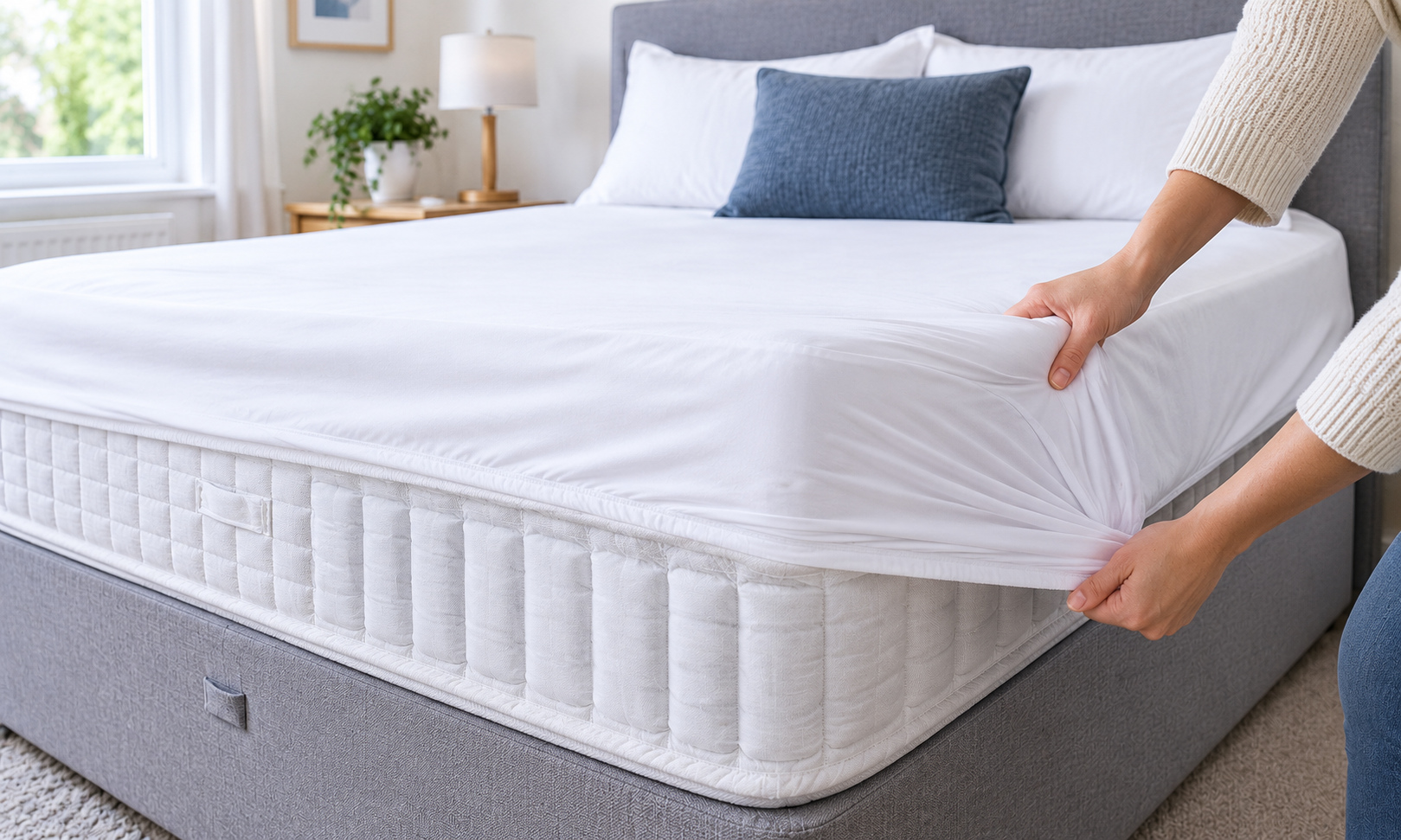
A mattress protector is a thin, washable cover that sits under your sheet and stops sweat, spills and dust reaching the mattress. Think of it as a phone case: cheap to replace, and far better than repairing what’s underneath.
Moisture matters more than most people think. Which? reports that the National Bed Federation estimates a mattress can absorb around a bathful of body moisture by age seven. Expert Reviews adds that moisture degrades foam and can cause mould.
Choose a breathable one, and replace it eventually: one retailer guide puts a protector’s own life at about one to two years.
2. Should you flip or rotate a mattress?
Rotate a mattress by turning it head to foot, and flip it only if it’s built with two usable sides. Most modern mattresses should be rotated and left the right way up, because flipping would put the hard support layer on top.
Expert Reviews explains (May 2024) that fewer mattresses can be flipped now, and that zoned mattresses, with different support under shoulders and hips, shouldn’t be rotated at all. Always check the label first.
| Mattress type | Rotate? | Flip? |
| Pocket sprung (one-sided) | Yes | No |
| Memory foam or memory pocket | Yes | No |
| Pillow top | Yes | No |
| Traditional two-sided sprung | Yes | Yes, about every six months |
| Zoned support | Check the label | No |
For timing, Expert Reviews suggests monthly in the first year and then about every three months. That matches what we advise in our buying guide: head to foot every three months. TechRadar (updated July 2022) says to turn more often if you and your partner differ a lot in height or weight.
Mattresses are heavy, so ask someone to help. Strip the bed first and turn in quarter turns.
3. Give it a solid, level base
A mattress is only as good as what it sits on, and a bowed or worn base shortens its life. Solid bases such as divans give the most support, according to Expert Reviews’ guide to mattress sag.
Slatted bases can work well if the slats are sturdy and closely spaced. Some warranties set a maximum gap between slats, and a four-legged slatted base may not carry a double or larger mattress well.
Check yours twice a year for bowing, broken slats and loose fittings. If you’re replacing it, browse our divan beds, ottoman divan beds or slatted ottoman beds. Our guide to how slatted and solid bases behave differently explains the trade-offs.
4. Keep it dry and let it breathe
A mattress that stays damp breaks down faster and can grow mould, so airing it is a habit worth keeping. Strip the bed and leave the mattress bare for a few hours every month or two, with the window open.
Blot any spill straight away and dry the area with a fan. One UK retailer also suggests a dehumidifier if condensation is a problem in your bedroom.
5. Clean it gently, and never soak it
Clean a mattress with as little liquid as possible, because soaking is one of the quickest ways to wreck the filling. Blot stains with mild detergent and cool water, then let the area dry fully before you remake the bed.
Brush or vacuum depends on the mattress. One retailer suggests vacuuming pocket sprung models every three to six months but brushing foam. Check the label either way.
6. Keep weight and wear off the edges
Don’t jump on the bed, and don’t sit on the edge for long. Both strain the springs and the edge support, and jumping speeds up wear on a sprung mattress.
Weight limits matter too. Expert Reviews notes that weight limits are typically around 130 to 140kg per person per side. Don’t stack one mattress on another, which strains both.
7. Never bend, fold or roll it
Bending, folding or rolling a mattress can displace the filling or damage the spring unit, and it may invalidate your warranty. Carry it flat, and use a mattress bag if you’re moving house.
If you need to store one, keep it flat in a dry, ventilated space.
8. Keep food, drink and pets out of bed
Eating, drinking and sleeping with pets all shorten a mattress’s life. In the NLWA survey, a quarter of people let pets sleep in bed and one in five ate there, with 8% doing so daily.
Spills bring moisture and stains, and claws wear the surface. You don’t have to ban the dog, but a washable throw over the protector helps.
9. Check for dips twice a year, and know your warranty
Some sinking into the mattress is normal, but a dip under the hips or shoulders that stays after you rotate it is not. Twice a year, strip the bed and look along the surface in daylight.
Warranty claims usually need a manufacturing fault, and sinkage must exceed normal wear, according to Expert Reviews. Rotation is often a condition too. Our mattresses carry a 1-year warranty against manufacturing faults, so read the terms for yours.
What does a mattress maintenance routine look like?
A mattress maintenance routine takes about ten minutes a month once it’s set up. Here’s one you can copy.
| Task | How often |
| Wash sheets and bedding | Weekly or fortnightly, hot where the label allows |
| Air the bare mattress | Every month or two, for a few hours |
| Rotate head to foot | Monthly in year one, then about every three months |
| Brush or vacuum gently | Every three to six months, if the label allows |
| Check the base and look for dips | Twice a year |
| Replace the protector | About every one to two years |
If your mattress is due a refresh, take a look at our mattresses, all cut to standard UK sizes.
When has a mattress reached the end, whatever you do?
A mattress has reached the end when it’s uncomfortable, visibly sagging, damaged or smells of damp that won’t clear. Which? lists four warning signs: discomfort, sagging, age or wear (over 10 years, or damaged foam and springs) and dirt or odour.
Care can’t undo years of wear. If a dip persists after rotating, or you wake aching, it’s time. The NLWA advises recycling an old mattress where possible.
Frequently asked questions
Does a mattress topper make a mattress last longer?
A topper can help, but it isn’t a substitute for a protector. It adds comfort and some padding on top, and Which? says a protector or topper can both help a mattress last longer. Choose a topper that suits the mattress, and still use a thin protector underneath or over it to handle sweat and spills.
Is a little sinking normal?
Yes. Mattresses soften and mould slightly to your body, and that’s different from problem sagging. A shallow, even impression is normal, but a clear dip under your hips or shoulders that remains after you rotate the mattress points to wear or a weak base. Check the base before you blame the mattress.
Does rotating a mattress affect the warranty?
Yes, it can. Rotation is often a warranty condition, according to Expert Reviews, so follow the care label and rotate on the schedule it gives. Keep your receipt and warranty paperwork too. If a dip appears, photograph it before contacting the retailer, because a claim usually needs evidence of a fault.
How long does a mattress protector last?
A mattress protector lasts about one to two years, according to one UK retailer’s guide, so it wears out well before the mattress does. Replace it when it’s thin, torn or no longer keeps liquid out. Washing it as the label directs keeps it working longer, and a fresh one costs far less than a new mattress.
How do you move a mattress without damaging it?
Keep it flat, protect it and use two people. Don’t bend, fold or roll it, because that can displace the filling or damage the spring unit. A mattress bag keeps off dirt and moisture. Larger sizes are heavy, so strip the bed first and ask for help, particularly on stairs.
Does a more expensive mattress last longer?
Often, but construction matters more than price. The NLWA suggests looking for natural latex, thicker coils and higher foam density, since these tend to last longer. Even then, a well-built mattress on a worn base or without a protector can fail early. Care and support count as much as the purchase price.
The bottom line on making a mattress last longer
Bottom line
- Start with a breathable protector, and rotate head to foot on a schedule.
- Give the mattress a solid, level base, and keep it dry.
- Keep weight off the edges, and don’t bend, fold or roll it.
- Check for dips twice a year, and replace the mattress when care no longer helps.
Questions about looking after a mattress or bed from us? Email info@jmhbeds.co.uk or get in touch with the team.
About the author: written by the JMH Beds team, a family-run business that builds beds and mattresses in West Yorkshire.


